> For the complete documentation index, see [llms.txt](https://coding-9.gitbook.io/untitled/llms.txt). Markdown versions of documentation pages are available by appending `.md` to page URLs; this page is available as [Markdown](https://coding-9.gitbook.io/untitled/trees/bst/99.-recover-binary-search-tree.md).
# 99. Recover Binary Search Tree
## Problem Statement
You are given the `root` of a binary search tree (BST), where the values of **exactly** two nodes of the tree were swapped by mistake. *Recover the tree without changing its structure*.
**Example 1:**
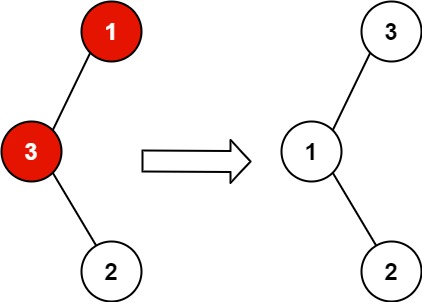
Input: root = [1,3,null,null,2]
Output: [3,1,null,null,2]
Explanation: 3 cannot be a left child of 1 because 3 > 1. Swapping 1 and 3 makes the BST valid.
**Example 2:**
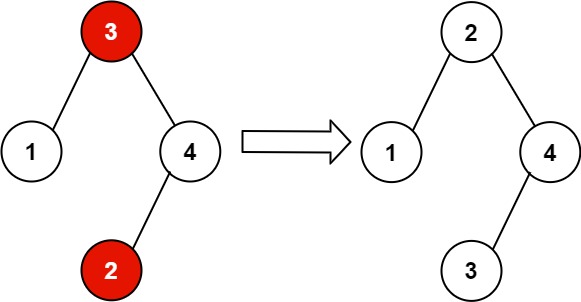
Input: root = [3,1,4,null,null,2]
Output: [2,1,4,null,null,3]
Explanation: 2 cannot be in the right subtree of 3 because 2 < 3. Swapping 2 and 3 makes the BST valid.
**Constraints:**
* The number of nodes in the tree is in the range `[2, 1000]`.
* `-231 <= Node.val <= 231 - 1`
## Intuition
```
Approach 1:
Brute
Sorting and comparing with actual inorder traversal
Approach 2:
3 1 2
Two cases,
Swapping are adjacent, not adjacent
Swapping are not afjacent,
Maintain the pointers
3 1 maintain 3->first, 1->middle
2 2->last
Voilation of a < b BST condition
Else if adjacent
Hence maintaing two pointers first and middle,
To swap them if at end we find last as null
```
### Links
### Video Links
### Approach 1:
```
Brute
```
{% code title="C++" lineNumbers="true" %}
```cpp
class Solution {
public:
vector> inorder, temp;
static bool comp(pair &a, pair&b){
return a.secondleft);
inorder.push_back({root, root->val});
temp.push_back({root, root->val});
traversal(root->right);
}
void recoverTree(TreeNode* root) {
traversal(root);
sort(temp.begin(), temp.end(), comp);
vector ans;
for(int i=0; ival = temp[i].second;
temp[i].first->val = inorder[i].second;
return ;
}
}
}
};
```
{% endcode %}
### Approach 2:
```
Optimal
```
{% code title="C++" lineNumbers="true" %}
```cpp
class Solution {
private:
TreeNode *prev = nullptr, *first = nullptr, *last = nullptr, *middle = nullptr;
void inorder(TreeNode* root) {
if (!root)
return;
inorder(root->left);
if (prev and root->val < prev->val) {
if (first == nullptr) {
first = prev;
middle = root;
}
else
last = root;
}
prev = root;
inorder(root->right);
}
public:
void recoverTree(TreeNode* root) {
inorder(root);
if(first and last) swap(first->val, last->val);
else swap(first->val, middle->val);
}
};
```
{% endcode %}
### Approach 3:
```
```
{% code title="C++" lineNumbers="true" %}
```cpp
```
{% endcode %}
### Approach 4:
```
```
{% code title="C++" lineNumbers="true" %}
```cpp
```
{% endcode %}
### Similar Problems
###