> For the complete documentation index, see [llms.txt](https://coding-9.gitbook.io/untitled/llms.txt). Markdown versions of documentation pages are available by appending `.md` to page URLs; this page is available as [Markdown](https://coding-9.gitbook.io/untitled/trees/binary-tree/hard/297.-serialize-and-deserialize-binary-tree.md).
# 297. Serialize and Deserialize Binary Tree
## Problem Statement
Serialization is the process of converting a data structure or object into a sequence of bits so that it can be stored in a file or memory buffer, or transmitted across a network connection link to be reconstructed later in the same or another computer environment.
Design an algorithm to serialize and deserialize a binary tree. There is no restriction on how your serialization/deserialization algorithm should work. You just need to ensure that a binary tree can be serialized to a string and this string can be deserialized to the original tree structure.
**Clarification:** The input/output format is the same as [how LeetCode serializes a binary tree](https://support.leetcode.com/hc/en-us/articles/360011883654-What-does-1-null-2-3-mean-in-binary-tree-representation-). You do not necessarily need to follow this format, so please be creative and come up with different approaches yourself.
**Example 1:**
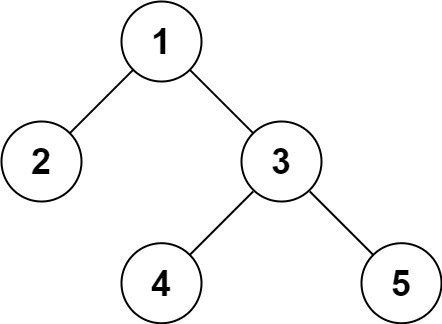
Input: root = [1,2,3,null,null,4,5]
Output: [1,2,3,null,null,4,5]
**Example 2:**
Input: root = []
Output: []
**Constraints:**
* The number of nodes in the tree is in the range `[0, 104]`.
* `-1000 <= Node.val <= 1000`
## Intuition
```
Approach:
We did by preorder
Root->left->right
Traversed like that
```
### Links
### Video Links
### Approach 1:
```
```
{% code title="C++" lineNumbers="true" %}
```cpp
class Codec {
public:
// Encodes a tree to a single string.
string serialize(TreeNode* root) {
string result = "";
preorderSerialize(root, result);
cout<val) + ',';
preorderSerialize(node->left, result);
preorderSerialize(node->right, result);
}
// also deserialize the tree through preorder traversal
TreeNode* preorderDeserialize(string& data, int& index) {
if (data[index] == '*') {
index += 2;
return NULL;
}
// check if the value of the node is negative
bool negative = false;
if (data[index] == '-') {
negative = true;
index++;
}
int value = 0;
while (data[index] != ',') {
value = value * 10 + (data[index] - '0');
index++;
}
if (negative) {
value = -value;
}
TreeNode* node = new TreeNode(value);
index++;
node->left = preorderDeserialize(data, index);
node->right = preorderDeserialize(data, index);
return node;
}
};
```
{% endcode %}
### Approach 2:
```
```
{% code title="C++" lineNumbers="true" %}
```cpp
```
{% endcode %}
### Approach 3:
```
```
{% code title="C++" lineNumbers="true" %}
```cpp
```
{% endcode %}
### Approach 4:
```
```
{% code title="C++" lineNumbers="true" %}
```cpp
```
{% endcode %}
### Similar Problems
###