> For the complete documentation index, see [llms.txt](https://coding-9.gitbook.io/untitled/llms.txt). Markdown versions of documentation pages are available by appending `.md` to page URLs; this page is available as [Markdown](https://coding-9.gitbook.io/untitled/trees/bst/1008.-construct-binary-search-tree-from-preorder-traversal.md).
# 1008. Construct Binary Search Tree from Preorder Traversal
## Problem Statement
Given an array of integers preorder, which represents the **preorder traversal** of a BST (i.e., **binary search tree**), construct the tree and return *its root*.
It is **guaranteed** that there is always possible to find a binary search tree with the given requirements for the given test cases.
A **binary search tree** is a binary tree where for every node, any descendant of `Node.left` has a value **strictly less than** `Node.val`, and any descendant of `Node.right` has a value **strictly greater than** `Node.val`.
A **preorder traversal** of a binary tree displays the value of the node first, then traverses `Node.left`, then traverses `Node.right`.
**Example 1:**
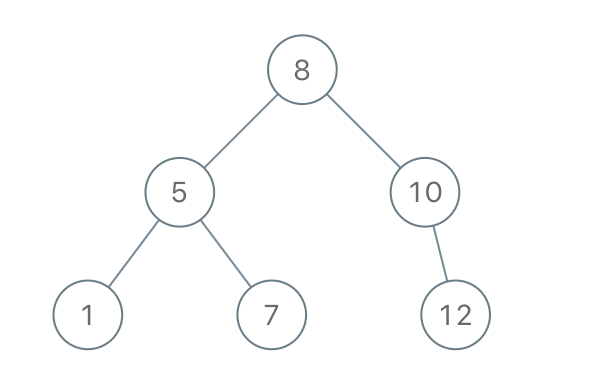
Input: preorder = [8,5,1,7,10,12]
Output: [8,5,10,1,7,null,12]
**Example 2:**
Input: preorder = [1,3]
Output: [1,null,3]
**Constraints:**
* `1 <= preorder.length <= 100`
* `1 <= preorder[i] <= 1000`
* All the values of `preorder` are **unique**.
## Intuition
```
Make an inorder, as BST so sorted of preorder
And apply the same concept of construction. By recursively building the tree
```
### Links
### Video Links
### Approach 1:
```
```
{% code title="C++" lineNumbers="true" %}
```cpp
class Solution {
public:
unordered_map mp;
TreeNode* Tree(vector& preorder, int p_start, int p_end, vector& inorder, int in_start, int in_end){
if(in_start > in_end)
return nullptr;
TreeNode* root = new TreeNode(preorder[p_start]);
int index = mp[preorder[p_start]];
int diff = index - in_start;
root->left = Tree(preorder, p_start+1, p_start+diff, inorder, in_start, index-1);
root->right = Tree(preorder, p_start+diff+1, p_end, inorder, index+1, in_end);
return root;
}
TreeNode* bstFromPreorder(vector& preorder) {
vector inorder(preorder);
sort(inorder.begin(), inorder.end());
for(int i=0;i